







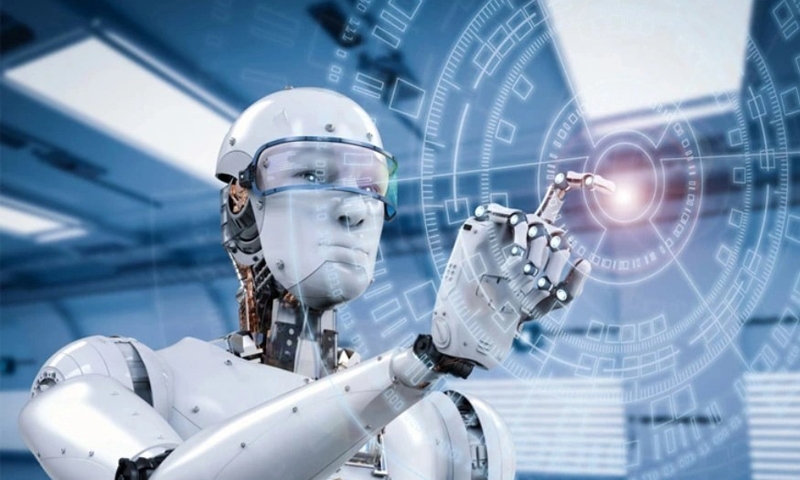
Surviving the Age of Artificial Intelligence
Every day, we are bombarded with news such as artificial intelligence (AI) that will replace workers, even snatching the jobs of senior personnel. And whether we like it or not, humanity will have to live with artificial intelligence.
Indeed, according to experts around the world, in the past decade, AI has made significant progress, surpassing human abilities in various tasks such as image and voice recognition, and even academic and professional tests.
Advances in AI are mainly driven by three factors. The first is the calculation with exponentially increased power. Next is the data. AI systems rely on huge amounts of data to train and make predictions. The more data an AI system has, the better its performance. Finally, the algorithm. AI developers have been optimizing algorithms to make the most of available computing power and data. Improved algorithms can lead to more efficient AI training and better performance.
The rapid advancement of AI will continue in the near future. This is due to the increasing computing power, the use of high-quality data left over on the internet, and constant algorithm innovation. There have even been concerns about the potential misuse of AI in critical areas such as cybersecurity, nuclear and biological technologies.
If AI continues to evolve at its current rate, one concern is that it leads to the prospect of more individuals being able to afford and access advanced scientific knowledge, which could be misused in various fields; and the majority of others are left behind because they do not have access to that advanced scientific knowledge.
For future generations, you have two choices: become the first to board the greatest technological train in human history, or soon join the “useless class” as Yuval Harari, historian and author of the bestselling book “Sapiens: A Brief History of Mankind”, “Homo Deus: A Brief History of the Future” and “21 Lessons for the 21st Century”.
How to survive in the age of artificial intelligence is a question that cannot be fully answered at this time. But at the very least, we can set out the principles and skills.
First, adaptation is a survival skill from the origin of all species since the founding of the world. Not the strongest, fastest, strongest one survives, but the one that adapts the fastest to circumstances will survive.
And so the need to grasp “vivid reality” is an urgent and vital requirement. The landscape around us, or in other words, the living and working environment, will change quite quickly, making the knowledge we have to “live, work and study” not enough to keep up with the times and survive. That requires continuous learning, lifelong learning.
If you are young, then you need to not only study continuously, but also learn faster than others. It is a competitive advantage in this day and age.
AI-related disciplines and jobs are more attractive than ever. The computer science department of Hanoi University of Science and Technology is an example, even the valedictorian of the high school graduation exam has failed. In the labor market of developed countries, good technology engineers are now as valuable as famous singers and actors. Netflix has recently advertised positions with a salary of $900,000 per year, or OpenAI (the company that owns ChatGPT software) with positions of up to $2 million.
Second, a basic but also important issue is health. We need to be healthy to embrace big changes and take place continuously like waves.
Change is the general law of the world despite the desires to resist it. However, the characteristic of this era is that the speed of technology is too fast, exponentially while human adaptation can only be linear. Because there is a gap between the two speeds and the distance is getting wider, it will lead to significant pressures on life. Our generation and our children will witness more life events than previous generations.
Third, an issue that each of us cannot decide, but can contribute to the impact, is science and technology policy in general, policy with artificial intelligence in particular. A community of knowledge and responsibility will positively influence policy, in the hope that humanity does not become a “slave” to AI.
Ultimately, the age of AI is not only a challenge but also an opportunity. Opportunities to grow, to learn, and to become a better version of ourselves in an increasingly complex world. Yes, the power of AI can be devastating and destructive, but it can also be a tool to solve humanity’s problems from climate change to medicine. The important thing is that we need to master technology, not let technology control us.
Remember, humans have one thing that AI has never had at the moment, which is love, creativity, and consciousness. Not only does this help us survive, but it also allows us to grow and prosper.
So, in the context of rapidly evolving AI and technology, let’s constantly seek insights, develop skills, and nourish the soul – three critical factors to not only survive but thrive in the new era.
In the face of uncertainty, we do not need to stand on the edge of despair, but see it as a stepping stone to rise higher. It’s our choice.